skip to main |
skip to sidebar
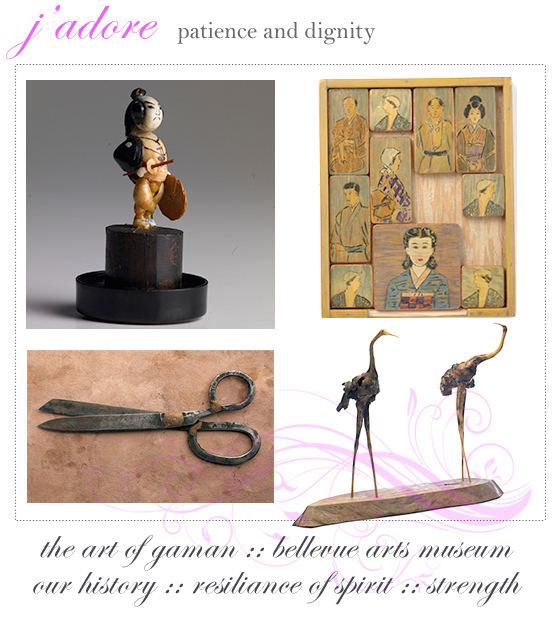 "Gaman" is a Japanese term for the act of enduring an unbearable situation with patience and dignity. The word is Buddhist in origin, a virtue of keeping one's mind and self strong and disciplined. It's also the title of the new exhibit at Bellevue Arts Museum, the Art of Gaman: Arts and Crafts from the Japanese Internment Camps. On display from now until October 12th, it's a unique collection of folk art, as well as everyday objects and possessions that internees made and kept with them during the 1942-1946 period where Americans of Japanese descent were removed from their homes and relocated in camps throughout the Southwest/Western half of the country. Gaman was a common term used by internees to give them the strength to bear such indignity, and their possessions and creative spirit are relics of our not-so-distant past that should never be forgotten.
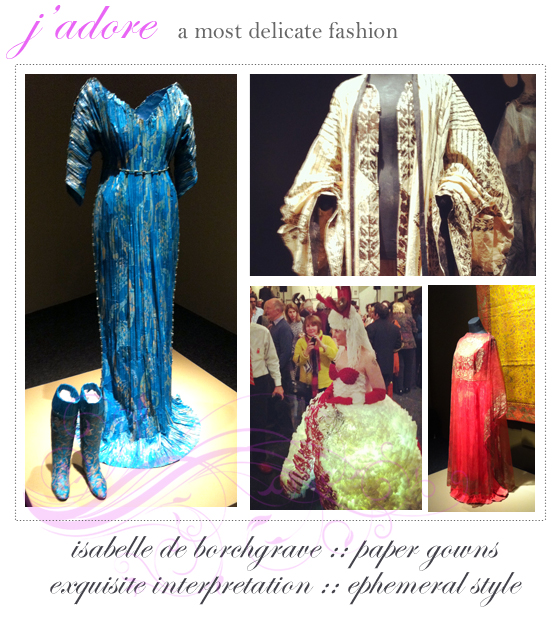 Well, did you survive the Thanksgiving-Black Friday-Cyber Monday-holiday? There's no escaping the fact that it's official: the Holidays Are Here. *dramatic music* But that doesn't mean you have to go into a hyper-holiday festive fit. How about giving yourself (and maybe a friend) a nice afternoon at the museum, looking at beautiful gowns, and zero pressure to shop, since... well, it's art, you just enjoy it.
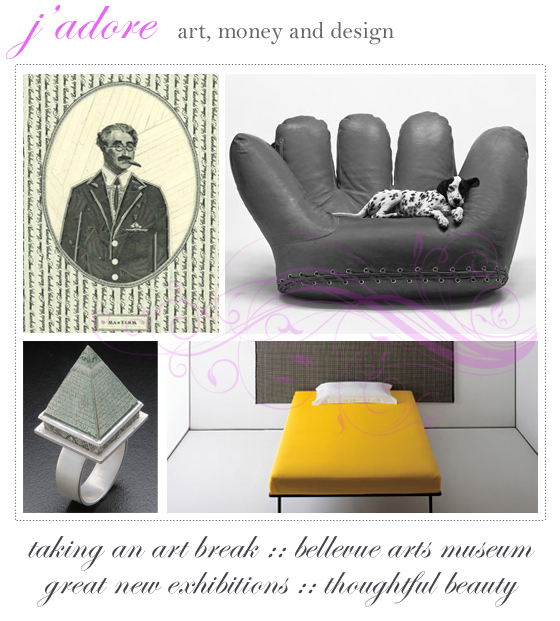 I gave myself a little treat over the weekend, I spent a couple of hours wandering through the latest exhibitions at the Bellevue Arts Museum and, as always, was delighted, surprised and drawn into the visual language of art. I went in to peruse one particular exhibit, and found myself spending time on all the floors, exploring everything, which is the best possible way to spend a day at the museum.
 The Magpie was very honored to meet artist Nikki McClure at the recent BAM Ignite event at the Bellevue Arts Museum. She has a stunning exhibit, Nikki McClure: Cutting Her Own Path, on display until February 3 of next year at The Bellevue Arts Musuem, which I highly recommend going to see, if you live in the area. Chances are you've probably seen her incredible cut paper illustration on book and album covers, and my personal favorite, on children's books, which I think showcases her work marvelously. The dramatic contrast of the cut black paper against white or colored backgrounds lend themselves perfectly for children's books, and her work has such a narrative storytelling aspect.
If you see Nikki McClure's exhibit, you get a chance to see original work and by getting up close, you can see every slice that renders a single piece of paper into a delicate lattice portrait. Admiring that level of handcraft and skill makes me think of jade or bone sculptures, where intricate carvings are made from a single piece of material. And she has a display of her sketchbooks and watercolors, along with a box of used Xacto blades to get a sense of her process and what it takes to inspire and create such beautiful pieces. Also -- put it on your calendar, she's doing a reading at Bellevue Arts Museum on December 8th, from 1-1:30pm! Visit the museum's event page for more details.
If you don't live in the area, fear not! Her books are my Fancy recommendation for the holidays. For the art collector and appreciator, {4} Collect Raindrops is a collection of McClure's work. There are fun books like {3} Things to Make and Do, to inspire the artist in everyone with simple projects. For the family she has several children's books like {2} Mama, Is It Summer Yet, {1} All In a Day, or for the mom to-be, {5} The First 1000 Days. I love giving her books to friends with children because there is always an emphasis on being close with nature and the whole food movement. It introduces simple, healthy habits to children like the benefits of gardening, going to a farmers market and just being hands-on with what goes on their plate. She's also done the cover art for grown-up books like Manifestos on the Future of Food and Seed, a collection of essays about the sustainable food movement.
Art that speaks to body and soul, this is something this Bird can flap her wings about. Nikki McClure's books can be found in bookstores and online, and a quick way to get them is at BuyOlympia.com -- that's where I did a bunch of shopping myself!
Jaunty Fine Print: Books available in stores, or for purchase on Nikki McClure's website
The Magpie was very honored to meet artist Nikki McClure at the recent BAM Ignite event at the Bellevue Arts Museum. She has a stunning exhibit, Nikki McClure: Cutting Her Own Path, on display until February 3 of next year at The Bellevue Arts Musuem, which I highly recommend going to see, if you live in the area. Chances are you've probably seen her incredible cut paper illustration on book and album covers, and my personal favorite, on children's books, which I think showcases her work marvelously. The dramatic contrast of the cut black paper against white or colored backgrounds lend themselves perfectly for children's books, and her work has such a narrative storytelling aspect.
If you see Nikki McClure's exhibit, you get a chance to see original work and by getting up close, you can see every slice that renders a single piece of paper into a delicate lattice portrait. Admiring that level of handcraft and skill makes me think of jade or bone sculptures, where intricate carvings are made from a single piece of material. And she has a display of her sketchbooks and watercolors, along with a box of used Xacto blades to get a sense of her process and what it takes to inspire and create such beautiful pieces. Also -- put it on your calendar, she's doing a reading at Bellevue Arts Museum on December 8th, from 1-1:30pm! Visit the museum's event page for more details.
If you don't live in the area, fear not! Her books are my Fancy recommendation for the holidays. For the art collector and appreciator, {4} Collect Raindrops is a collection of McClure's work. There are fun books like {3} Things to Make and Do, to inspire the artist in everyone with simple projects. For the family she has several children's books like {2} Mama, Is It Summer Yet, {1} All In a Day, or for the mom to-be, {5} The First 1000 Days. I love giving her books to friends with children because there is always an emphasis on being close with nature and the whole food movement. It introduces simple, healthy habits to children like the benefits of gardening, going to a farmers market and just being hands-on with what goes on their plate. She's also done the cover art for grown-up books like Manifestos on the Future of Food and Seed, a collection of essays about the sustainable food movement.
Art that speaks to body and soul, this is something this Bird can flap her wings about. Nikki McClure's books can be found in bookstores and online, and a quick way to get them is at BuyOlympia.com -- that's where I did a bunch of shopping myself!
Jaunty Fine Print: Books available in stores, or for purchase on Nikki McClure's website
 It's been two years in a row that I've been shooting photos at Artsfair, the weekend-long artist streetfair that literally takes over downtown Bellevue. It's actually like a trifecta of art festivals, as there's a couple of smaller ones that run adjacent, but Artsfair is the main attraction, giving space to over a hundred different vendors, both local and out of state, offering them the opportunity to chat with the crowds and sell their unique hand-crafted goods directly to the public. Sponsored by the Bellevue Arts Museum, this festival has been going on for several years, it always happens towards the end of summer and inevitably, fortune tends to smile down upon this weekend with good weather.
The Bird was on shutterbug duty on Friday, the opening day of the festival, and it was a great opportunity to not only capture fun moments, like the artists being selected to win a special award, or the kids doing crafts and making little derby cars, but you wander through every row of artist booths, so you literally see everything. These are the days you put your walking shoes on, as you're on your feet for hours, no time to rest, as there's always something happening that you want to take a photo of. It's one of those days where you break for lunch at 4pm and don't realize how long you've been up and running!
Despite it being summer, I totally have the holidays on the Jaunty Brain. Sure, you could buy your gifts online, head to a shopping mall or just send a gift card, but how fantastic is it to talk to the person who made the jewelry or sewed the article of clothing? You get a story with each piece and make a connection with the artist. There's artists of all sorts, from two dimensional, to textiles, to jewelry. A lot of the two dimensional artists sell smaller prints of their work, so you don't have to buy the original piece to take a bit of the experience home with you. I personally got several prints from a couple of artists as gifts -- Diane Archer and Cori Dantini -- they're like little treasures you share with someone special. And of course I browsed the jewelers' tables. So many to choose from. I had to go with the sustainability of Kathleen Plate's Smart Glass Jewelry -- she makes beautiful, organic looking jewelry from reclaimed soda and wine bottles, plus incredible chandeliers, which you can see one in the photos above. I also couldn't resist picking up a little something whimsical and lovely from Della Goheen Millinery for an upcoming birthday gift. Why no photos of the goods? Because they're all gifts and it's just getting too close to birthdays and holidays to spoil everything, of course! But please check out their links and blogs. I think you'll find their work as charming, personal and unique as I did.
There were so many artists I wanted to support, but my little bird budget could only stretch so far. However, these artists made the cut and I'm looking forward to passing along these finds to lucky loved ones this year. Take this to heart and consider shopping at a local arts and crafts fair, or pick some favorite artists on Etsy for your special occasion shopping. It's never too early to get your holiday shopping done and there's always a birthday or special occasion on the horizon, so why not make the gift extra-special for that extra-special person?
Jaunty Fine Print: photographs by Denise Sakaki
It's been two years in a row that I've been shooting photos at Artsfair, the weekend-long artist streetfair that literally takes over downtown Bellevue. It's actually like a trifecta of art festivals, as there's a couple of smaller ones that run adjacent, but Artsfair is the main attraction, giving space to over a hundred different vendors, both local and out of state, offering them the opportunity to chat with the crowds and sell their unique hand-crafted goods directly to the public. Sponsored by the Bellevue Arts Museum, this festival has been going on for several years, it always happens towards the end of summer and inevitably, fortune tends to smile down upon this weekend with good weather.
The Bird was on shutterbug duty on Friday, the opening day of the festival, and it was a great opportunity to not only capture fun moments, like the artists being selected to win a special award, or the kids doing crafts and making little derby cars, but you wander through every row of artist booths, so you literally see everything. These are the days you put your walking shoes on, as you're on your feet for hours, no time to rest, as there's always something happening that you want to take a photo of. It's one of those days where you break for lunch at 4pm and don't realize how long you've been up and running!
Despite it being summer, I totally have the holidays on the Jaunty Brain. Sure, you could buy your gifts online, head to a shopping mall or just send a gift card, but how fantastic is it to talk to the person who made the jewelry or sewed the article of clothing? You get a story with each piece and make a connection with the artist. There's artists of all sorts, from two dimensional, to textiles, to jewelry. A lot of the two dimensional artists sell smaller prints of their work, so you don't have to buy the original piece to take a bit of the experience home with you. I personally got several prints from a couple of artists as gifts -- Diane Archer and Cori Dantini -- they're like little treasures you share with someone special. And of course I browsed the jewelers' tables. So many to choose from. I had to go with the sustainability of Kathleen Plate's Smart Glass Jewelry -- she makes beautiful, organic looking jewelry from reclaimed soda and wine bottles, plus incredible chandeliers, which you can see one in the photos above. I also couldn't resist picking up a little something whimsical and lovely from Della Goheen Millinery for an upcoming birthday gift. Why no photos of the goods? Because they're all gifts and it's just getting too close to birthdays and holidays to spoil everything, of course! But please check out their links and blogs. I think you'll find their work as charming, personal and unique as I did.
There were so many artists I wanted to support, but my little bird budget could only stretch so far. However, these artists made the cut and I'm looking forward to passing along these finds to lucky loved ones this year. Take this to heart and consider shopping at a local arts and crafts fair, or pick some favorite artists on Etsy for your special occasion shopping. It's never too early to get your holiday shopping done and there's always a birthday or special occasion on the horizon, so why not make the gift extra-special for that extra-special person?
Jaunty Fine Print: photographs by Denise Sakaki

 It had been too long since this Bird wandered the halls of the Bellevue Arts Museum. Renewing my membership for the year was a good reminder to take a break from a nonstop work schedule and take some time for thoughtful observation. Aside from taking in some really beautiful new exhibits, it was a good refresher to one's own creative process that one must always be taking in other people's art, ensuring the work we produce remains informed.
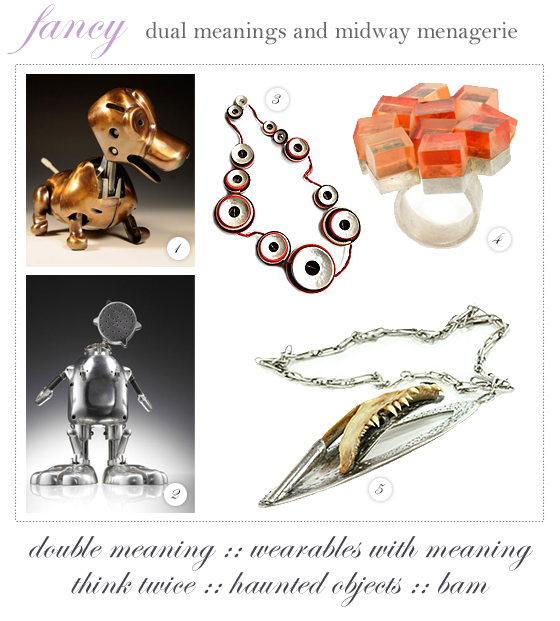
The latest exhibits that caught this Birdy's Fancy are the Think Twice: New Latin American Jewelry and Cathy McClure: Midway. They're both exceptionally different collections, but they have a theme of objects and meaning; how everyday things, whether ornamental or mundane, can suddenly become striking when put in a new context. Maybe that's just a "well, duh" observation of art as a whole, but I really appreciated the Latin American jewelry exhibit that showed some truly beautiful wearable art that was infused with strong stories and emotion. Pieces that encased photo negatives in resin, multiplied many times and applied to a ring or a pin, implying a sense of time captured and then made sacred. There's a plantain covered in platinum and made into a necklace; a gaudy piece meant to point out the absurdity of ostentatious status jewelry but also a sense of cultural loss, as the organic plantain is meant to rot within its precious metal cage, while the physical ghost of the object remains. I liked this collection as it forces you to really investigate each piece, given their small size; you have to go up close and examine it from all angles, as several pieces have hidden visuals that you'll miss if you don't really explore it. The materials are all chosen with poignance and intent, keeping the line between artistic statement and aesthetic wearable blurry and thoughtfully obscured.
The new Cathy McClure Midway installation is a more environmental experience. There are standalone pieces of ticky-tack toy-like animals that greet you with an expectation of off-kilter whimsy, but when you enter the full exhibit, you're surrounded by eerily macabre sounds, objects and moments of light and dark; you're no longer in the museum, you're stepping into the artist's mind. Installation pieces that really envelop the viewer can sometimes be difficult for people to appreciate; it's a little off-putting to go from being the observer, looking at objects on a wall or encased in glass, and then feel like you're literally walking into the nexus of an art piece, where every part of the space is used and there is no safety of a protective glass case or the obvious outline of a frame to separate one from the art. It's the observer that becomes the alien element, and there's an unnerving feeling associated with that. But I think that's where art becomes really visceral and real, a reminder that it should go beyond the typical "Oh, that's a nice painting," and something more interactive and modern, requesting the viewer to become immersed in the work. McClure's Midway pieces are a Tim Burton-esque lullaby to childhood and memories that inevitably become tinged with time and adulthood. The objects themselves are cheery and whimsical, with patchwork robots and animals built with familiar utensils and appliance parts, but when displayed in an installation that has shadowy lights, a silent film looping of one of her creations hopping around, and an impressive mini carousel that dances in the periodic burst of strobe lights, the exhibit takes on a larger story of childhood treasures in a state of decay and worry. The carousel spins with its Steampunk-ish figures and creatures in Eadweard Muybridge-like duplications of incremental motion, so that when the strobe hits them, the eye reads it as fluid motion and they cast a haunting shadow around the white walls.
These exhibits are very different, but they will absolutely leave one feeling alive and inspired in different ways, as both observer and participant in the artist's message. There is no right or wrong answer when enjoying art; it's a very human thing to overlay one's own experiences with a piece, even if it doesn't exactly match the artist's intent -- I think that's by design. An artist can't be so full of hubris to expect every viewer to take away the same reaction they had when creating the piece; art is communal and I think creatives understand that one should take away their own personal interaction with a piece, as that's where art ceases to merely be an object, but a soulful connection.
Jaunty Fine Print: photos from the Bellevue Arts Museum; work by {1, 2} Cathy Mc Clure, {4} Claudia Cucchi, {5}Renny Golcman, {3} Linda Sanchez
It had been too long since this Bird wandered the halls of the Bellevue Arts Museum. Renewing my membership for the year was a good reminder to take a break from a nonstop work schedule and take some time for thoughtful observation. Aside from taking in some really beautiful new exhibits, it was a good refresher to one's own creative process that one must always be taking in other people's art, ensuring the work we produce remains informed.
The latest exhibits that caught this Birdy's Fancy are the Think Twice: New Latin American Jewelry and Cathy McClure: Midway. They're both exceptionally different collections, but they have a theme of objects and meaning; how everyday things, whether ornamental or mundane, can suddenly become striking when put in a new context. Maybe that's just a "well, duh" observation of art as a whole, but I really appreciated the Latin American jewelry exhibit that showed some truly beautiful wearable art that was infused with strong stories and emotion. Pieces that encased photo negatives in resin, multiplied many times and applied to a ring or a pin, implying a sense of time captured and then made sacred. There's a plantain covered in platinum and made into a necklace; a gaudy piece meant to point out the absurdity of ostentatious status jewelry but also a sense of cultural loss, as the organic plantain is meant to rot within its precious metal cage, while the physical ghost of the object remains. I liked this collection as it forces you to really investigate each piece, given their small size; you have to go up close and examine it from all angles, as several pieces have hidden visuals that you'll miss if you don't really explore it. The materials are all chosen with poignance and intent, keeping the line between artistic statement and aesthetic wearable blurry and thoughtfully obscured.
The new Cathy McClure Midway installation is a more environmental experience. There are standalone pieces of ticky-tack toy-like animals that greet you with an expectation of off-kilter whimsy, but when you enter the full exhibit, you're surrounded by eerily macabre sounds, objects and moments of light and dark; you're no longer in the museum, you're stepping into the artist's mind. Installation pieces that really envelop the viewer can sometimes be difficult for people to appreciate; it's a little off-putting to go from being the observer, looking at objects on a wall or encased in glass, and then feel like you're literally walking into the nexus of an art piece, where every part of the space is used and there is no safety of a protective glass case or the obvious outline of a frame to separate one from the art. It's the observer that becomes the alien element, and there's an unnerving feeling associated with that. But I think that's where art becomes really visceral and real, a reminder that it should go beyond the typical "Oh, that's a nice painting," and something more interactive and modern, requesting the viewer to become immersed in the work. McClure's Midway pieces are a Tim Burton-esque lullaby to childhood and memories that inevitably become tinged with time and adulthood. The objects themselves are cheery and whimsical, with patchwork robots and animals built with familiar utensils and appliance parts, but when displayed in an installation that has shadowy lights, a silent film looping of one of her creations hopping around, and an impressive mini carousel that dances in the periodic burst of strobe lights, the exhibit takes on a larger story of childhood treasures in a state of decay and worry. The carousel spins with its Steampunk-ish figures and creatures in Eadweard Muybridge-like duplications of incremental motion, so that when the strobe hits them, the eye reads it as fluid motion and they cast a haunting shadow around the white walls.
These exhibits are very different, but they will absolutely leave one feeling alive and inspired in different ways, as both observer and participant in the artist's message. There is no right or wrong answer when enjoying art; it's a very human thing to overlay one's own experiences with a piece, even if it doesn't exactly match the artist's intent -- I think that's by design. An artist can't be so full of hubris to expect every viewer to take away the same reaction they had when creating the piece; art is communal and I think creatives understand that one should take away their own personal interaction with a piece, as that's where art ceases to merely be an object, but a soulful connection.
Jaunty Fine Print: photos from the Bellevue Arts Museum; work by {1, 2} Cathy Mc Clure, {4} Claudia Cucchi, {5}Renny Golcman, {3} Linda Sanchez
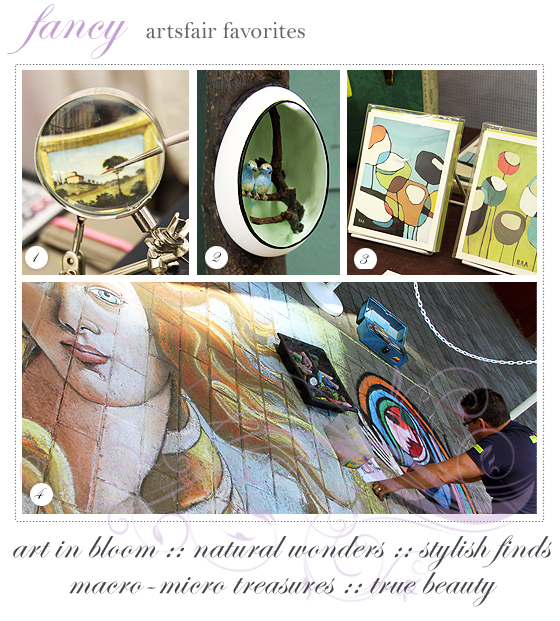 The Magpie didn't get a chance to post photos from the recent Artsfair festival that happened the weekend before taking off for vacation. Presented by the Bellevue Arts Museum, this annual weekend-long fair is a chance for artists from all over the country to show off their talent and for people to talk directly with the creative minds behind the work. Wandering around, these were some favorites that I took a particular shine to - take a look at their sites, as I think you'll agree they're all unique talents! {1} Christina Goodman, hand painted miniatures and jewelry, {2} J. Brooke Patterson, J.B.W. Studio - little worlds inside real eggshells, {3} Rachel Ann Austin, paintings and other lovelies, {4} Brian Major, Major Arts masterwork murals
Jaunty Fine Print: photos by Denise Sakaki
The Magpie didn't get a chance to post photos from the recent Artsfair festival that happened the weekend before taking off for vacation. Presented by the Bellevue Arts Museum, this annual weekend-long fair is a chance for artists from all over the country to show off their talent and for people to talk directly with the creative minds behind the work. Wandering around, these were some favorites that I took a particular shine to - take a look at their sites, as I think you'll agree they're all unique talents! {1} Christina Goodman, hand painted miniatures and jewelry, {2} J. Brooke Patterson, J.B.W. Studio - little worlds inside real eggshells, {3} Rachel Ann Austin, paintings and other lovelies, {4} Brian Major, Major Arts masterwork murals
Jaunty Fine Print: photos by Denise Sakaki
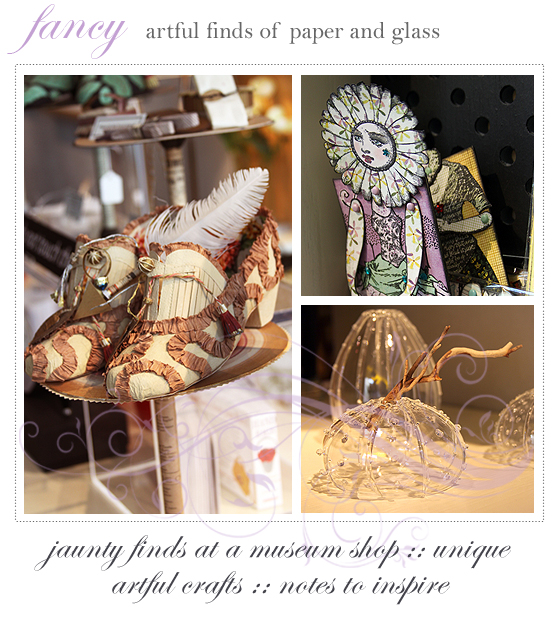 One of my favorite Jaunty shops to browse in for gift ideas is the Bellevue Arts Museum store, as they have a lot of unique finds, many by local artists. They recently had an event where Museum members were invited to sip bubbly, nibble of chocolates and shop with the benefit of a nice discount. I was too busy snapping up photos to snap up deals, but my Jaunty shutterbug eye nabbed a few favorites.
The unique paper shoes were of course beautiful, as were the delicate glass sea urchin vases, but I often gravitate towards cards when I'm at Jaunty shops. I think letter writing is sadly becoming a lost art, but when there are still paper artists making handmade cards that look like little dancing dolls, or stitched shapes cut from beautiful paper, how could someone not want to send a special note or three? Even if the most beautiful of baubles are too much for one's pocketbook, a beautiful card with a handwritten note can be both priceless and affordable. It's a small object that's easily kept and treasured, slipped away in a box of keepsakes for someone to find later and be reminded of such a loving gesture. I know Mother's Day was just last week, but maybe we don't need an official reason to send a note to someone in the mail. Sometimes the best gifts are the little kind thoughts that are sent without reason.
Jaunty Fine Print: photos by Denise Sakaki, courtesy of the Bellevue Arts Museum shop
One of my favorite Jaunty shops to browse in for gift ideas is the Bellevue Arts Museum store, as they have a lot of unique finds, many by local artists. They recently had an event where Museum members were invited to sip bubbly, nibble of chocolates and shop with the benefit of a nice discount. I was too busy snapping up photos to snap up deals, but my Jaunty shutterbug eye nabbed a few favorites.
The unique paper shoes were of course beautiful, as were the delicate glass sea urchin vases, but I often gravitate towards cards when I'm at Jaunty shops. I think letter writing is sadly becoming a lost art, but when there are still paper artists making handmade cards that look like little dancing dolls, or stitched shapes cut from beautiful paper, how could someone not want to send a special note or three? Even if the most beautiful of baubles are too much for one's pocketbook, a beautiful card with a handwritten note can be both priceless and affordable. It's a small object that's easily kept and treasured, slipped away in a box of keepsakes for someone to find later and be reminded of such a loving gesture. I know Mother's Day was just last week, but maybe we don't need an official reason to send a note to someone in the mail. Sometimes the best gifts are the little kind thoughts that are sent without reason.
Jaunty Fine Print: photos by Denise Sakaki, courtesy of the Bellevue Arts Museum shop
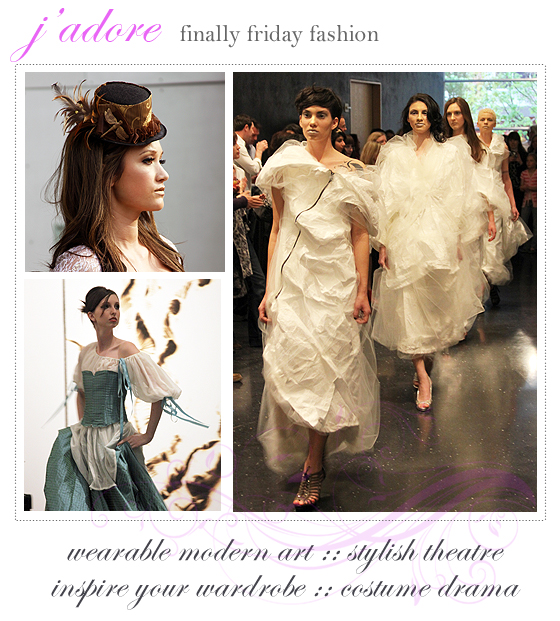
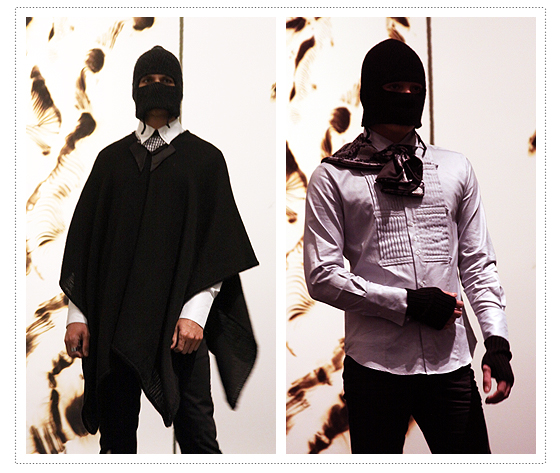
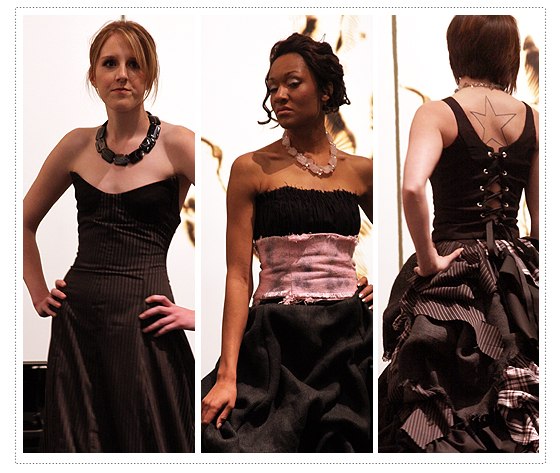
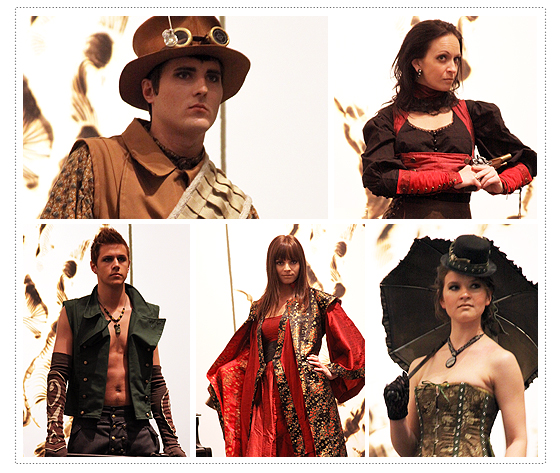
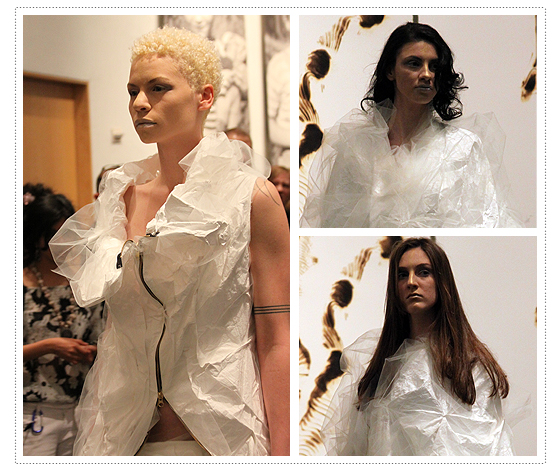
As promised, here are some photos from the recent Bellevue Arts Museum's (BAM) first Finally Friday event, a party where they celebrated recently opened exhibits such as the shoe designs of the fashion forward Beth Levine. To keep the stylish theme, BAM's Finally Friday also featured a runway fashion show, organized by Steven Matsumoto and his team at Stigmare Couture Marketing, featuring the works of local Seattle designers: Poirier Couture, Built for Man, Bri Seeley, Last Wear and Neodandi Couture.
Because this Bird understands the power of a picture being worth a thousand words, I'll just let the clothing speak for themselves, showing off a small sample of the stylish talent we are lucky enough to have in the Emerald City.
Here are some of the strong, feminine designs from Poirier Couture: 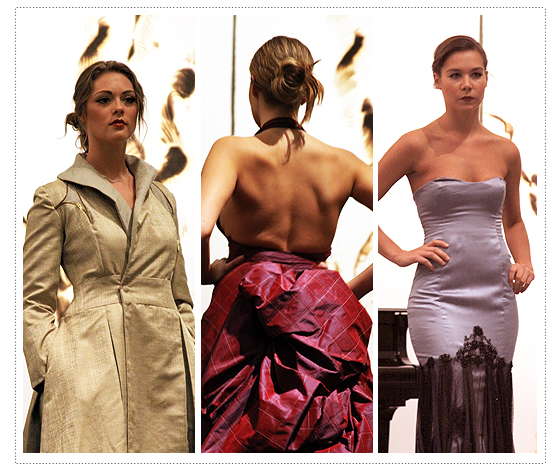 Here are a couple of the dramatic pieces from Built for Man:
 Feminine silhouettes mixed with menswear fabric - pieces from Bri Seeley Designs
 Steampunk style, fresh from the pages of Jules Verne, the look of Last Wear:
 Ethereal and ghostly, the hauntingly beautiful work of Neodandi Couture:
 Much Jaunty Thanks to the Bellevue Arts Museum and their sponsors for helping to put together such a stylish Finally Friday event! And the tipping of a Jaunty hat to Stigmare for organizing such a great sampling of Seattle designers. Still wanting more fresh fashion from the Pacific Northwest? Keep an eye out for the upcoming Emerald City Fashion Week!
Jaunty Fine Print: photos by Denise Sakaki
Much Jaunty Thanks to the Bellevue Arts Museum and their sponsors for helping to put together such a stylish Finally Friday event! And the tipping of a Jaunty hat to Stigmare for organizing such a great sampling of Seattle designers. Still wanting more fresh fashion from the Pacific Northwest? Keep an eye out for the upcoming Emerald City Fashion Week!
Jaunty Fine Print: photos by Denise Sakaki
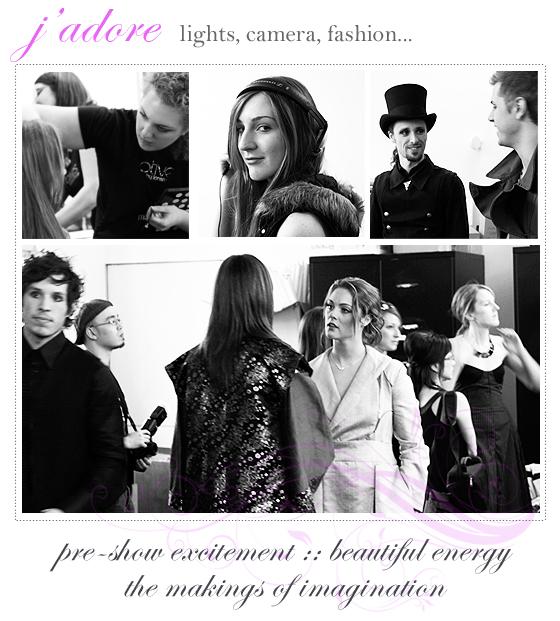 Sometimes it's the anticipation and energy before the event that makes for the real show to see. The Magpie was a lucky bird, able to take a peek at some of the behind the scenes preparation before the runway show at Bellevue Arts Museum's first Finally Friday event for 2010.
A chance to show off the talents of local Seattle designers, Built for Man, Bri Seeley, Poirier Couture, Last Wear and Neodandi Couture, the preparation behind a fashion show can be as interesting to see as the runway result. Tables full of rainbow-hued makeup kits, hair being styled, models in everyday wear being transformed into something other-worldly and truly imaginative -- it's like a little bit of magic happening before one's eyes. Stay tuned this week to see more photos of the Finally Friday fashion show, so you can see the final result of this creative and artful event.
Jaunty Fine Print: photos by Denise Sakaki
Sometimes it's the anticipation and energy before the event that makes for the real show to see. The Magpie was a lucky bird, able to take a peek at some of the behind the scenes preparation before the runway show at Bellevue Arts Museum's first Finally Friday event for 2010.
A chance to show off the talents of local Seattle designers, Built for Man, Bri Seeley, Poirier Couture, Last Wear and Neodandi Couture, the preparation behind a fashion show can be as interesting to see as the runway result. Tables full of rainbow-hued makeup kits, hair being styled, models in everyday wear being transformed into something other-worldly and truly imaginative -- it's like a little bit of magic happening before one's eyes. Stay tuned this week to see more photos of the Finally Friday fashion show, so you can see the final result of this creative and artful event.
Jaunty Fine Print: photos by Denise Sakaki
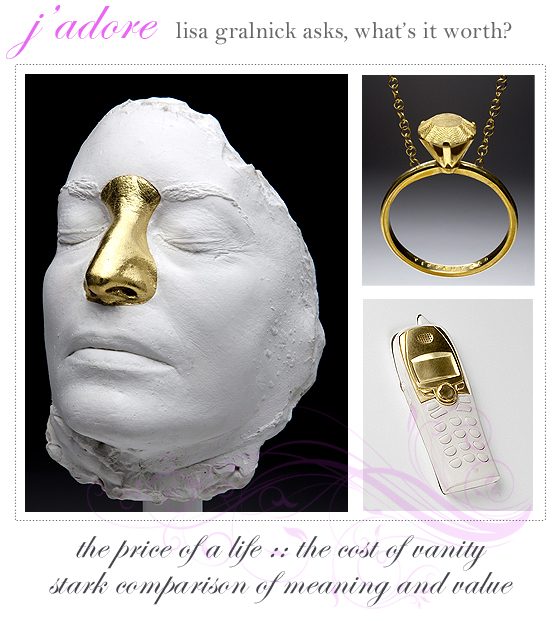 Those MasterCard ads where they go down the list of line items in dollar amounts before hitting the final life-lesson displaying their signature emotional hook, "Priceless," is memorable because it makes us think about the value behind the things we purchase. It's of course ironic that it's a credit card company that's making this point, but for a ten cent lesson in value judgement, it gives you a moment of pause to consider the real worth behind objects. This Bird had the opportunity to wander through the Bellevue Arts Museum latest exhibition, The Gold Standard, by artist Lisa Gralnick, which asks the same questions about the commodities of life, in a compelling, even unnerving way.
A metalsmith by trade, Lisa Gralnick takes her knowledge of casting objects and applies it to a three-part series on display at BAM from February 18 through August 1st. The first part, Commodification and Sensible Economy is the most striking and relevant, as it illustrates in physical form, the monetary value of our habits, desires, and vanities. Using pristine white plaster, Gralnick perfectly casts everyday objects with particular segments in 18K gold. The eye immediately goes to the gleaming portions of precious metal, standing out against the ghostly pale of the plaster -- some are large areas, some are so small, you have to hunt for it. Gralnick uses the amount of gold equal to the value of these everyday things -- a gold bit in the mobile phone is the cost of a cel phone bill, a string of gold pills attached like a delicate necklace is the cost of antidepressants, and the eerie cast of a face with the gilded nose uses the precious metal to illustrate the cost of a nose job. Haunting, indeed.
Walking through the displays of common objects with hints or whole sections cast in gold is a self-reflective experience, where one can't help but question the difference between value and worth. A nugget-sized portion of gold fused in a collection of white coffee bags compounds the cost of those seemingly harmless afternoon latte breaks. The vaccum cleaner perfectly captured in plaster, down to the detail of the dustbag's texture, forces one to search for where the gold is located, making the viewer realize how society values the labor force in America.
From benign, everyday things to objects of vanity and excess, no one is left untouched by this haunting artwork. There's no irony lost on the fact that it's on display right in the center of downtown Bellevue, across the street from the giant shopping mall, but like the role of good art, it will make people stop and think. Instead of simply asking what an item costs, perhaps people should be asking what value will this item bring into this life?
Jaunty Fine Print: Photo credits from left to right, going clockwise:
Lisa Gralnick
Those MasterCard ads where they go down the list of line items in dollar amounts before hitting the final life-lesson displaying their signature emotional hook, "Priceless," is memorable because it makes us think about the value behind the things we purchase. It's of course ironic that it's a credit card company that's making this point, but for a ten cent lesson in value judgement, it gives you a moment of pause to consider the real worth behind objects. This Bird had the opportunity to wander through the Bellevue Arts Museum latest exhibition, The Gold Standard, by artist Lisa Gralnick, which asks the same questions about the commodities of life, in a compelling, even unnerving way.
A metalsmith by trade, Lisa Gralnick takes her knowledge of casting objects and applies it to a three-part series on display at BAM from February 18 through August 1st. The first part, Commodification and Sensible Economy is the most striking and relevant, as it illustrates in physical form, the monetary value of our habits, desires, and vanities. Using pristine white plaster, Gralnick perfectly casts everyday objects with particular segments in 18K gold. The eye immediately goes to the gleaming portions of precious metal, standing out against the ghostly pale of the plaster -- some are large areas, some are so small, you have to hunt for it. Gralnick uses the amount of gold equal to the value of these everyday things -- a gold bit in the mobile phone is the cost of a cel phone bill, a string of gold pills attached like a delicate necklace is the cost of antidepressants, and the eerie cast of a face with the gilded nose uses the precious metal to illustrate the cost of a nose job. Haunting, indeed.
Walking through the displays of common objects with hints or whole sections cast in gold is a self-reflective experience, where one can't help but question the difference between value and worth. A nugget-sized portion of gold fused in a collection of white coffee bags compounds the cost of those seemingly harmless afternoon latte breaks. The vaccum cleaner perfectly captured in plaster, down to the detail of the dustbag's texture, forces one to search for where the gold is located, making the viewer realize how society values the labor force in America.
From benign, everyday things to objects of vanity and excess, no one is left untouched by this haunting artwork. There's no irony lost on the fact that it's on display right in the center of downtown Bellevue, across the street from the giant shopping mall, but like the role of good art, it will make people stop and think. Instead of simply asking what an item costs, perhaps people should be asking what value will this item bring into this life?
Jaunty Fine Print: Photo credits from left to right, going clockwise:
Lisa Gralnick
The Gold Standard Part I: #8 Rhinoplasty
2005
Plaster, gold and acrylic
16 x 16 x 15
Collection: Susan Beech
Photo: Jim Escalante
Lisa Gralnick
The Gold Standard Part I: #11 Tiffany Ring
2005
Gold, acrylic
2 x 40 x 16 in.
Collection of Rotasa Trust
Photo: Jim Escalante
Lisa Gralnick
The Gold Standard Part I: #3 Cell Phone
2003
Plaster, gold, acrylic
30 x 20 x 16
Courtesy of the artist
Photo: Jim Escalante
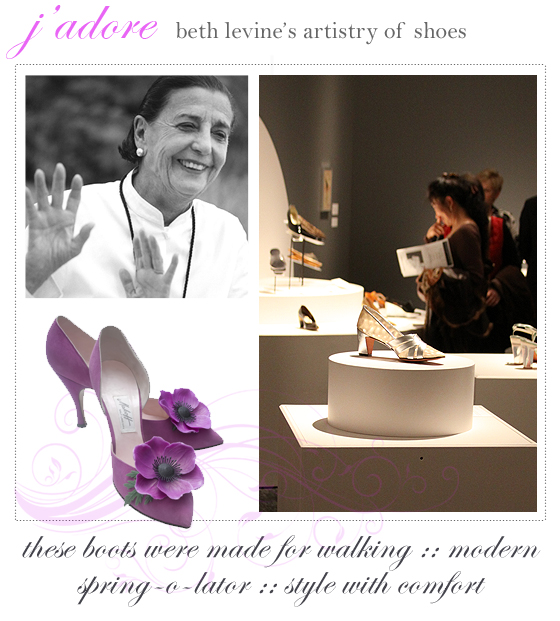 The next time you look at a fashionable boot, a bejeweled shoe, a dainty mule, or even a stiletto heel, think of Beth Levine.
 An American shoe designer that pioneered many of the construction and aesthetic aspects of modern fashion footwear from the 1940s through the 1970s, Levine's name has sadly been forgotten while European designer names like Manolo and Louboutin sit firmly at the forefront of people's minds when they think of high-end shoe design. The Bellevue Arts Museum (BAM) has a new exhibit that will undoubtedly reintroduce Beth Levine's name into our memory bank of stylemakers and educate over America's own history as the home of many shoe design innovations.
On view from February 18th through June 6th, Beth Levine: First Lady of Shoes will have its only U.S. visit at BAM, displaying an extensive collection of vintage originals of Levine's design, as well as drawings, ads and other rare paperwork that document this amazing career in fashion. Co-curator and personal friend of Levine, designer Helene Verin was on-hand for the exhibit's preview night to give a detailed retrospective of Beth Levine's life and career as a true vanguard of shoe design, breaking down gender barriers and becoming one of the most celebrated female designers of her time. Wearing a silver and vinyl pair of Levine's shoes from her own collection, Verin listed the impressive list of celebrities and politicians that Beth Levine worked with to get her shoes on their feet. Celebrities like Cher and Barbara Streisand, and White House royalty including Jacqueline Kennedy, had all come to Beth Levine to create shoes that were both fashion-forward and (gasp!) comfortable. In our modern time of sky-high sculptural heels that threaten to defy the forces of nature, Levine took on shoe design from both an artistic and pragmatic perspective, as she had the understanding that the shoes needed to be as wearable as they were beautiful. She would test her designs personally, making sure the shoes that left the Levine factory could stand up to a busy day of walking around.
One of her most notable construction innovations was the Spring-o-lator, a discreet device built within the shoe to keep the foot from slipping out in backless/mule designs. Levine also had the vision to take the humble workboot and make it form-fitting, feminine, and truly show off a woman's natural assets. We take the fashionable boot for granted, but at the time, it was such a unique fashion statement that it inspired Nancy Sinatra's unforgettable "These Boots Were Made for Walking" song in the 1960s. The accolades and pop cultural references were of course flattering, but Levine remained an artist dedicated to her craft. The museum exhibit showcased an impressive array of conceptual shoes made with different materials like paper, AstroTurf, and her early forays into the vinyl and lucite "invisible" shoes. Her work is an inspiration, as it shows such a wide array of ideas, all beautiful, whimsical and experimental, constantly thinking of ways to deconstruct the shoe and reexamine the way a foot interacted with it.
Looking through today's department stores or recent fashion magazine spreads, it's easy to see Beth Levine's influence over shoe design as a whole. People who may not be familiar with her name have still had her artistry touch their lives, whether it's a rhinestone-decorated shoe or the perfect pair of knee-high boots that hug the leg in all the right places. She understood the nature of fashion, as the famous saying for Levine shoes was that they were, "ones that nobody needed, but everybody wanted." Her design truly sung the music of the fashion-forward soul, and now it's thankfully on display until June for many to become better acquainted with her name and her contributions to the delights that decorate our feet.
Much Jaunty thanks to the Bellevue Arts Museum for hosting this exhibit, as well as to Nordstrom, in their support of the musuem and helping to bring treasured collections like these to the Pacific Northwest.
Jaunty Fine Print: Photo of Beth Levine, 1999, by Bruce Weber; Anemone d' Orsay, designed by Beth Levine, 1959, pink suede d'Orsay with lavender plastic flower ornament, courtesy Helene Verin, photo by David Hamsley; photo of exhibit by Denise Sakaki
An American shoe designer that pioneered many of the construction and aesthetic aspects of modern fashion footwear from the 1940s through the 1970s, Levine's name has sadly been forgotten while European designer names like Manolo and Louboutin sit firmly at the forefront of people's minds when they think of high-end shoe design. The Bellevue Arts Museum (BAM) has a new exhibit that will undoubtedly reintroduce Beth Levine's name into our memory bank of stylemakers and educate over America's own history as the home of many shoe design innovations.
On view from February 18th through June 6th, Beth Levine: First Lady of Shoes will have its only U.S. visit at BAM, displaying an extensive collection of vintage originals of Levine's design, as well as drawings, ads and other rare paperwork that document this amazing career in fashion. Co-curator and personal friend of Levine, designer Helene Verin was on-hand for the exhibit's preview night to give a detailed retrospective of Beth Levine's life and career as a true vanguard of shoe design, breaking down gender barriers and becoming one of the most celebrated female designers of her time. Wearing a silver and vinyl pair of Levine's shoes from her own collection, Verin listed the impressive list of celebrities and politicians that Beth Levine worked with to get her shoes on their feet. Celebrities like Cher and Barbara Streisand, and White House royalty including Jacqueline Kennedy, had all come to Beth Levine to create shoes that were both fashion-forward and (gasp!) comfortable. In our modern time of sky-high sculptural heels that threaten to defy the forces of nature, Levine took on shoe design from both an artistic and pragmatic perspective, as she had the understanding that the shoes needed to be as wearable as they were beautiful. She would test her designs personally, making sure the shoes that left the Levine factory could stand up to a busy day of walking around.
One of her most notable construction innovations was the Spring-o-lator, a discreet device built within the shoe to keep the foot from slipping out in backless/mule designs. Levine also had the vision to take the humble workboot and make it form-fitting, feminine, and truly show off a woman's natural assets. We take the fashionable boot for granted, but at the time, it was such a unique fashion statement that it inspired Nancy Sinatra's unforgettable "These Boots Were Made for Walking" song in the 1960s. The accolades and pop cultural references were of course flattering, but Levine remained an artist dedicated to her craft. The museum exhibit showcased an impressive array of conceptual shoes made with different materials like paper, AstroTurf, and her early forays into the vinyl and lucite "invisible" shoes. Her work is an inspiration, as it shows such a wide array of ideas, all beautiful, whimsical and experimental, constantly thinking of ways to deconstruct the shoe and reexamine the way a foot interacted with it.
Looking through today's department stores or recent fashion magazine spreads, it's easy to see Beth Levine's influence over shoe design as a whole. People who may not be familiar with her name have still had her artistry touch their lives, whether it's a rhinestone-decorated shoe or the perfect pair of knee-high boots that hug the leg in all the right places. She understood the nature of fashion, as the famous saying for Levine shoes was that they were, "ones that nobody needed, but everybody wanted." Her design truly sung the music of the fashion-forward soul, and now it's thankfully on display until June for many to become better acquainted with her name and her contributions to the delights that decorate our feet.
Much Jaunty thanks to the Bellevue Arts Museum for hosting this exhibit, as well as to Nordstrom, in their support of the musuem and helping to bring treasured collections like these to the Pacific Northwest.
Jaunty Fine Print: Photo of Beth Levine, 1999, by Bruce Weber; Anemone d' Orsay, designed by Beth Levine, 1959, pink suede d'Orsay with lavender plastic flower ornament, courtesy Helene Verin, photo by David Hamsley; photo of exhibit by Denise Sakaki




 Posts
Posts


