skip to main |
skip to sidebar
 The moment you hear the line: "May the Odds Be Ever in Your Favor," this Birdie had chills running down her spine. Of course I saw The Hunger Games the day it opened. And to get to the point: Yes, it was Awesomesauce. I rarely look forward to movies these days, it's like saying, "Here's ten bucks, entertain me at a mediocre level and fill me with regret over not spending the cash on a cheeseburger." I saw previews for another reboot of the Spiderman franchise, Titanic re-relased in another dimension of seeing Leo go down with the ship, and a cheesy 70's parody of Dark Shadows. But that one's by Tim Burton and I kind of admit I'm intrigued, as I loved that goofy show. The Twilight preview made me giggle, as I feel like The Hunger Games is like the antithesis of teenage vampire-werewolves in heat. But at long last, after most of my illicit smuggled-in snacks were eaten, the real show began...
Oh, and what a show it was! I admit, I'm biased because I love-love-loved Suzanne Collins' The Hunger Games book series. It's not flawless, and neither is the movie, but for something with the Scholastic Press publishing label slapped on it, the story is satisfyingly mature. A lot of people were commenting on Facebook how they didn't know what the big deal was and they were maybe a little timid about giving a "young adult" book series a try. I blame toe-gazer Twilight for making people suspicious about giving books like this a read. No one batted an eye about sharing the same book as your second grader about the boy-wizard named Harry, so there's no reason to assume The Hunger Games will feel like kiddie fare or being trapped too long on the Isle of Emo-Teens.
The movie adaptation of The Hunger Games compliments the book nicely. Yes, certain details are left out, but themes of the story remain true: sacrifice, resilience, and defiance. There is as much meaty material for adults as there is for teenagers. There are lessons hashed out in a fictional dystopia that can be applied to the things you see on the news today: teenagers being shot and killed by fearful authorities, protestors demanding economic revolution, class warfare reaching a flash point. Children and young adults are dying in our present-day, sacrificed on an altar of nightly news and political agenda -- this "tween" book series perfectly frames our current reality in a manner that asks the real question: how do we begin to heal what is broken?
I'm not going to spoil anything, because I think you should see/read it for yourself, but for fans of the book, seeing the movie bring to life the words that described "The Girl on Fire," made me want to cheer, and Amandla Stenberg, who plays Rue, could not have been more heartbreakingly perfect. Jennifer Lawrence does a fantastic job as Katniss Everdeen. She embodies the stubborn, emotionally self-contained heroine. She doesn't choose to be a champion for a deranged society, but accepts it because it's a means to an end to keep her family safe. Life isn't perfect; cowboy-up. The scene where she's seconds from being released into the arena for battle, the subtle tremors of fear causing stray tendrils of her hair to quiver so slightly, will make you want to hold a loved one extra-tight. The movie perfectly illustrates a population stuck in a rift of economic disparity where the poor are weakened to near starvation and the rich bask in ridiculous, offensive frivolity. The only thing more offensive than the rich is their Roman gladatorial-styled Hunger Games, pitting selected youth against one another until a lone survivor remains, and the winning home district is awarded with additional supplies. The young characters carry this storyline, and a twisted ideal of hope upon their shoulders. When they are abandoned to savagery in the arena, it's intentionally disturbing, a reminder to never let times become so desperate. The intrusive media influence, capturing every emotion and interplay is meant to be a jab at our own obsession with reality TV. Our current reality may not be this severe, but enough elements exist to make the story relatable, uncomfortable, and with an uncertainty that leaves you wondering what's to come.
The moment you hear the line: "May the Odds Be Ever in Your Favor," this Birdie had chills running down her spine. Of course I saw The Hunger Games the day it opened. And to get to the point: Yes, it was Awesomesauce. I rarely look forward to movies these days, it's like saying, "Here's ten bucks, entertain me at a mediocre level and fill me with regret over not spending the cash on a cheeseburger." I saw previews for another reboot of the Spiderman franchise, Titanic re-relased in another dimension of seeing Leo go down with the ship, and a cheesy 70's parody of Dark Shadows. But that one's by Tim Burton and I kind of admit I'm intrigued, as I loved that goofy show. The Twilight preview made me giggle, as I feel like The Hunger Games is like the antithesis of teenage vampire-werewolves in heat. But at long last, after most of my illicit smuggled-in snacks were eaten, the real show began...
Oh, and what a show it was! I admit, I'm biased because I love-love-loved Suzanne Collins' The Hunger Games book series. It's not flawless, and neither is the movie, but for something with the Scholastic Press publishing label slapped on it, the story is satisfyingly mature. A lot of people were commenting on Facebook how they didn't know what the big deal was and they were maybe a little timid about giving a "young adult" book series a try. I blame toe-gazer Twilight for making people suspicious about giving books like this a read. No one batted an eye about sharing the same book as your second grader about the boy-wizard named Harry, so there's no reason to assume The Hunger Games will feel like kiddie fare or being trapped too long on the Isle of Emo-Teens.
The movie adaptation of The Hunger Games compliments the book nicely. Yes, certain details are left out, but themes of the story remain true: sacrifice, resilience, and defiance. There is as much meaty material for adults as there is for teenagers. There are lessons hashed out in a fictional dystopia that can be applied to the things you see on the news today: teenagers being shot and killed by fearful authorities, protestors demanding economic revolution, class warfare reaching a flash point. Children and young adults are dying in our present-day, sacrificed on an altar of nightly news and political agenda -- this "tween" book series perfectly frames our current reality in a manner that asks the real question: how do we begin to heal what is broken?
I'm not going to spoil anything, because I think you should see/read it for yourself, but for fans of the book, seeing the movie bring to life the words that described "The Girl on Fire," made me want to cheer, and Amandla Stenberg, who plays Rue, could not have been more heartbreakingly perfect. Jennifer Lawrence does a fantastic job as Katniss Everdeen. She embodies the stubborn, emotionally self-contained heroine. She doesn't choose to be a champion for a deranged society, but accepts it because it's a means to an end to keep her family safe. Life isn't perfect; cowboy-up. The scene where she's seconds from being released into the arena for battle, the subtle tremors of fear causing stray tendrils of her hair to quiver so slightly, will make you want to hold a loved one extra-tight. The movie perfectly illustrates a population stuck in a rift of economic disparity where the poor are weakened to near starvation and the rich bask in ridiculous, offensive frivolity. The only thing more offensive than the rich is their Roman gladatorial-styled Hunger Games, pitting selected youth against one another until a lone survivor remains, and the winning home district is awarded with additional supplies. The young characters carry this storyline, and a twisted ideal of hope upon their shoulders. When they are abandoned to savagery in the arena, it's intentionally disturbing, a reminder to never let times become so desperate. The intrusive media influence, capturing every emotion and interplay is meant to be a jab at our own obsession with reality TV. Our current reality may not be this severe, but enough elements exist to make the story relatable, uncomfortable, and with an uncertainty that leaves you wondering what's to come.
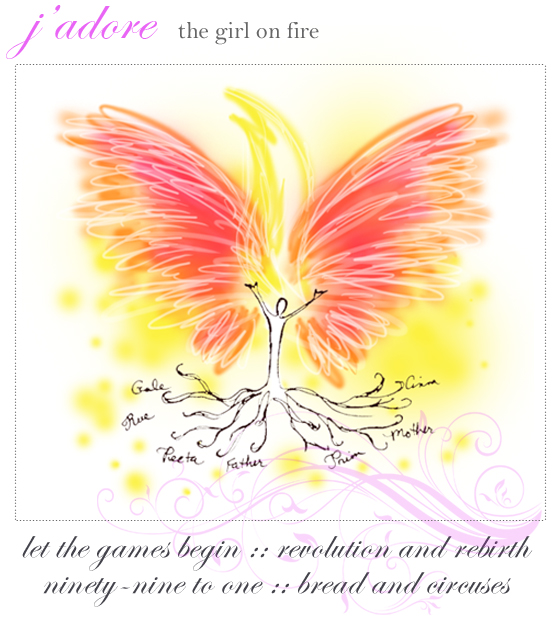
Jaunty Fine Print: illustration by Denise Sakaki, inspired by The Hunger Games
 This Bird has always been fascinated by the sparkling truth of documentary films, as they highlight a little detail in the fabric of daily life, one that's often overlooked by the news, which seems to focus on singular cataclysmic events that are for the most part, momentary. Documentarians like Michael Moore gets a bit gonzo at times, so I've been gravitating towards smaller films that appear quiet on the surface, but a swirl of human debate lies below the calm. I remember seeing a preview for filmmaker Yung Chang's documentary, Up the Yangtze
 , several years ago and was immediately haunted by the visuals of a mythically beautiful river cutting through deep valleys enrobed in mist, set against the contemporary issue of progress's path as it brings China into the 21st Century.
Chang's story focuses on the consequences of China's Three Gorges Dam, a longtime project originally conceived during the days of Chairman Mao, and now reaches fruition in our current century. The dam's purpose is to harness the great Yangtze River and convert it into hydroelectric energy, addressing China's need for resources as a growing global power. Not all of its rural cities have electricity and the country still relies heavily on coal-burning; the need for alternative energy sources has been a longtime question weighing on the nation as a whole, and the Three Gorges Dam is one potential answer. It's an epic feat of engineering, but takes a steep human toll -- as a result of the dam and re-routing the river's flow, it's caused the water level to rise and flood many riverside cities, resulting in two million people being uprooted. Livelihoods have been lost for those who farmed on the river's banks, and many have been forcibly moved without proper recompensation from the government. The issue is monumental, there is no clear resolution, and the documentary Up the Yangtze offers small glimpses into a handful of lives that are directly affected by the dam and the future it promises.
The most poignant figures in the film are the Yu family, and their daughter Yu Shui, barely fourteen and having to take a job on one of the tourist cruise ships that ferry Western visitors up the river, wanting to see the lands before the Yangtze swallows them up forever. Yu Shui's parents are poor subsistence farmers, living on the river's edge with no electricity, but using the land to provide their food. The slowly rising water threatens to engulf their home, so they know it is only a matter of time before they must relocate, but that means moving into a city apartment at a higher cost of living, which they can't afford without having land to farm. It's a terrible Catch-22 the family faces, so this leads them to the reluctant and ironic decision to send their eldest daughter, Yu Shui, to get a job on the cruise ship and hopefully provide enough income to both support the family and her own dream to get a university education. You can't help but cringe at moments where the Western tourists dress up in silly costumes of imperial Chinese royalty for photos and eat like kings in the massive cruise ship dining hall. And then you see Yu Shui -- given a Westernized name, Cindy, like all the workers on the ship -- talking to her parents and marveling at being able to have the luxury of meat more than once a week. The job provides "Cindy" a steady income along with English lessons, things that could keep a roof over her family's head and potentially propel her own future, but at the cost of her personal identity and the adoption of Western consumerism habits that may spend the money before she has a chance to send it home.
Up the Yangtze paints a very real picture of China as a nation, not the pastoral landscape the government-run tourism industry would prefer the world to see. Not to say it's a completely unflattering portrait -- it's beautiful in its complexity, heartbreakingly poignant in the loss of history in the name of evolution, and unflinchingly handsome in its reality. There is no simple answer, and all you can do is weep for those who are crushed under the heavy wheel of progress, and wish good fortune on the next generation who will hopefully bring a better future for this rapidly-changing nation. It's a great documentary because it doesn't provide a clear resolution, merely provoke the deeper issue everyone must come to terms with regarding the Devil's bargain of economic passage and the inevitable toll it takes on humanity.
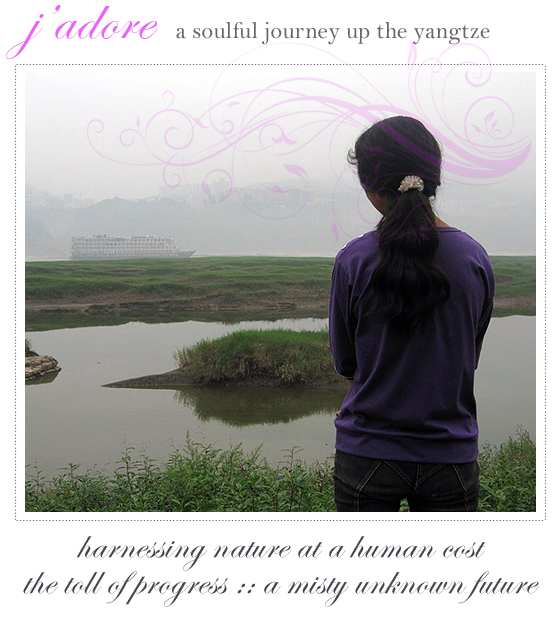
Jaunty Fine Print: photo from Up the Yangtze website
, several years ago and was immediately haunted by the visuals of a mythically beautiful river cutting through deep valleys enrobed in mist, set against the contemporary issue of progress's path as it brings China into the 21st Century.
Chang's story focuses on the consequences of China's Three Gorges Dam, a longtime project originally conceived during the days of Chairman Mao, and now reaches fruition in our current century. The dam's purpose is to harness the great Yangtze River and convert it into hydroelectric energy, addressing China's need for resources as a growing global power. Not all of its rural cities have electricity and the country still relies heavily on coal-burning; the need for alternative energy sources has been a longtime question weighing on the nation as a whole, and the Three Gorges Dam is one potential answer. It's an epic feat of engineering, but takes a steep human toll -- as a result of the dam and re-routing the river's flow, it's caused the water level to rise and flood many riverside cities, resulting in two million people being uprooted. Livelihoods have been lost for those who farmed on the river's banks, and many have been forcibly moved without proper recompensation from the government. The issue is monumental, there is no clear resolution, and the documentary Up the Yangtze offers small glimpses into a handful of lives that are directly affected by the dam and the future it promises.
The most poignant figures in the film are the Yu family, and their daughter Yu Shui, barely fourteen and having to take a job on one of the tourist cruise ships that ferry Western visitors up the river, wanting to see the lands before the Yangtze swallows them up forever. Yu Shui's parents are poor subsistence farmers, living on the river's edge with no electricity, but using the land to provide their food. The slowly rising water threatens to engulf their home, so they know it is only a matter of time before they must relocate, but that means moving into a city apartment at a higher cost of living, which they can't afford without having land to farm. It's a terrible Catch-22 the family faces, so this leads them to the reluctant and ironic decision to send their eldest daughter, Yu Shui, to get a job on the cruise ship and hopefully provide enough income to both support the family and her own dream to get a university education. You can't help but cringe at moments where the Western tourists dress up in silly costumes of imperial Chinese royalty for photos and eat like kings in the massive cruise ship dining hall. And then you see Yu Shui -- given a Westernized name, Cindy, like all the workers on the ship -- talking to her parents and marveling at being able to have the luxury of meat more than once a week. The job provides "Cindy" a steady income along with English lessons, things that could keep a roof over her family's head and potentially propel her own future, but at the cost of her personal identity and the adoption of Western consumerism habits that may spend the money before she has a chance to send it home.
Up the Yangtze paints a very real picture of China as a nation, not the pastoral landscape the government-run tourism industry would prefer the world to see. Not to say it's a completely unflattering portrait -- it's beautiful in its complexity, heartbreakingly poignant in the loss of history in the name of evolution, and unflinchingly handsome in its reality. There is no simple answer, and all you can do is weep for those who are crushed under the heavy wheel of progress, and wish good fortune on the next generation who will hopefully bring a better future for this rapidly-changing nation. It's a great documentary because it doesn't provide a clear resolution, merely provoke the deeper issue everyone must come to terms with regarding the Devil's bargain of economic passage and the inevitable toll it takes on humanity.
Jaunty Fine Print: photo from Up the Yangtze website






 Posts
Posts


